The Tangent - I Thought Musical Chairs Was for Real Estate
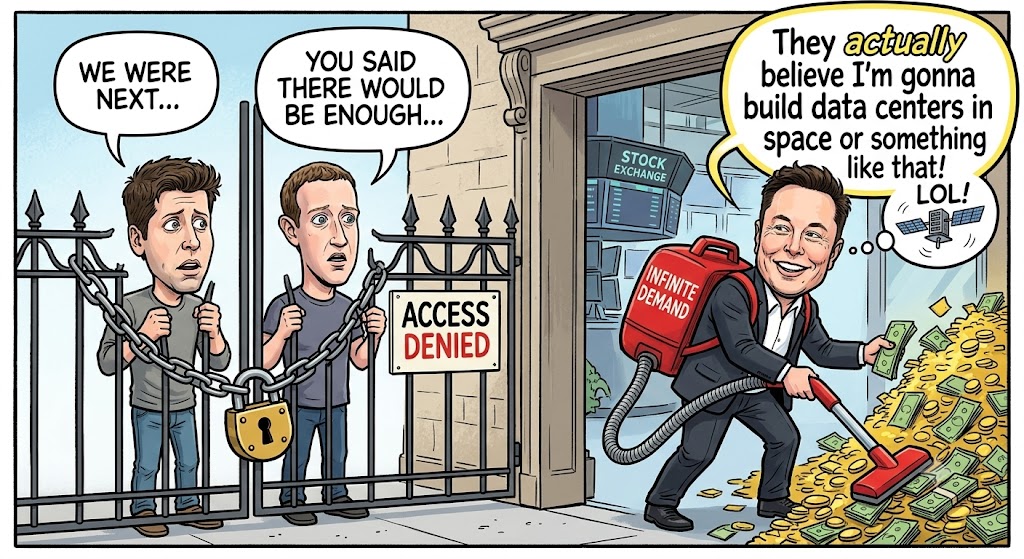
I find AI fascinating. Not the technology — those of you who know me know I'm a power user, and that's not the interesting part.
What I can't look away from is the drama. The stakes. The sheer amount of money involved.
You don't have to dig very deep to understand what's going on. What they're building isn't a machine. It's a furnace that incinerates money. The whole model depends on raising a bigger pile to feed the fire before the last one burns down. Why? Because they spend tens of billions of dollars to produce an asset that depreciates in a couple of months — long enough for the Chinese or open source to copy a good enough version. And even during that short window, they're still losing money on it.
Case in point: one anonymous enterprise customer accidentally ran up a $500 million Claude bill in a single month because nobody set a usage cap. This is a true story. Half a billion dollars in one month.
Outside of accidents like that, these firms may be hard pressed to find anyone actually willing to pay the non subsidized cost.
What am I saying, for those I'm losing? Your $100 monthly GPT subscription probably costs the company a few thousand dollars or more in compute. You're getting a subsidized experience because they're trying to grow awareness and subscribers.
They've now gotten so big that the private well is running dry. The checks are too large for anyone but the public markets to write — which is why the biggest names on earth are suddenly filing to go public. Not because they're ready. Because it's the only tap left that's big enough.
Enter the bag holder. The IPO buyer.
And here's the part I find genuinely thrilling to watch: there may not be enough to go around. When everyone rushes the same pool at once, somebody gets caught standing when the music stops.
Does anyone really believe data centers are getting built in space? Did Musk just shortcut the entire IPO line? Because it's honestly impressive. Huge paper loss on Twitter — whatever, roll it up into xAI while the money's flowing. Grok's not going to win the frontier, so forget the frontier model; we'll become a neocloud instead. Basically Sunbelt Rentals for the AI world: buy a chip that depreciates in who knows how long, then lease it out. Then take the neocloud and roll that up into the rocket company — a real company, no doubt, but one that runs at a loss and did less than $20 billion in revenue last year (against the $2T and something market cap it hit at the high post IPO). And now all of the sudden, it’s data centers in space, against a $28.5 trillion TAM.
Just to be clear: SpaceX's total addressable market — $28.5 trillion — is about 93% of the entire US economy. With China and Russia excluded from the math.
And here — finally — is the musical chairs. But it's not the version we know. In our world, the music stops and it's one developer left holding a half empty spec warehouse he broke ground on at the top of the market. Here it's four companies circling the same chair, and only one or two will pull enough liquidity out of the public markets to stay standing. Same game, a few more zeros — except this time the one left without a seat isn't the developer. It's whoever bought the IPO.
I’ve got some conviction with all of this, but I wouldn’t say I have enough to place any actual bets. Can’t guarantee I’m going to be right about any of these outcomes. I just find this story so much more thrilling than Netflix.