The Game is About to Change, Again
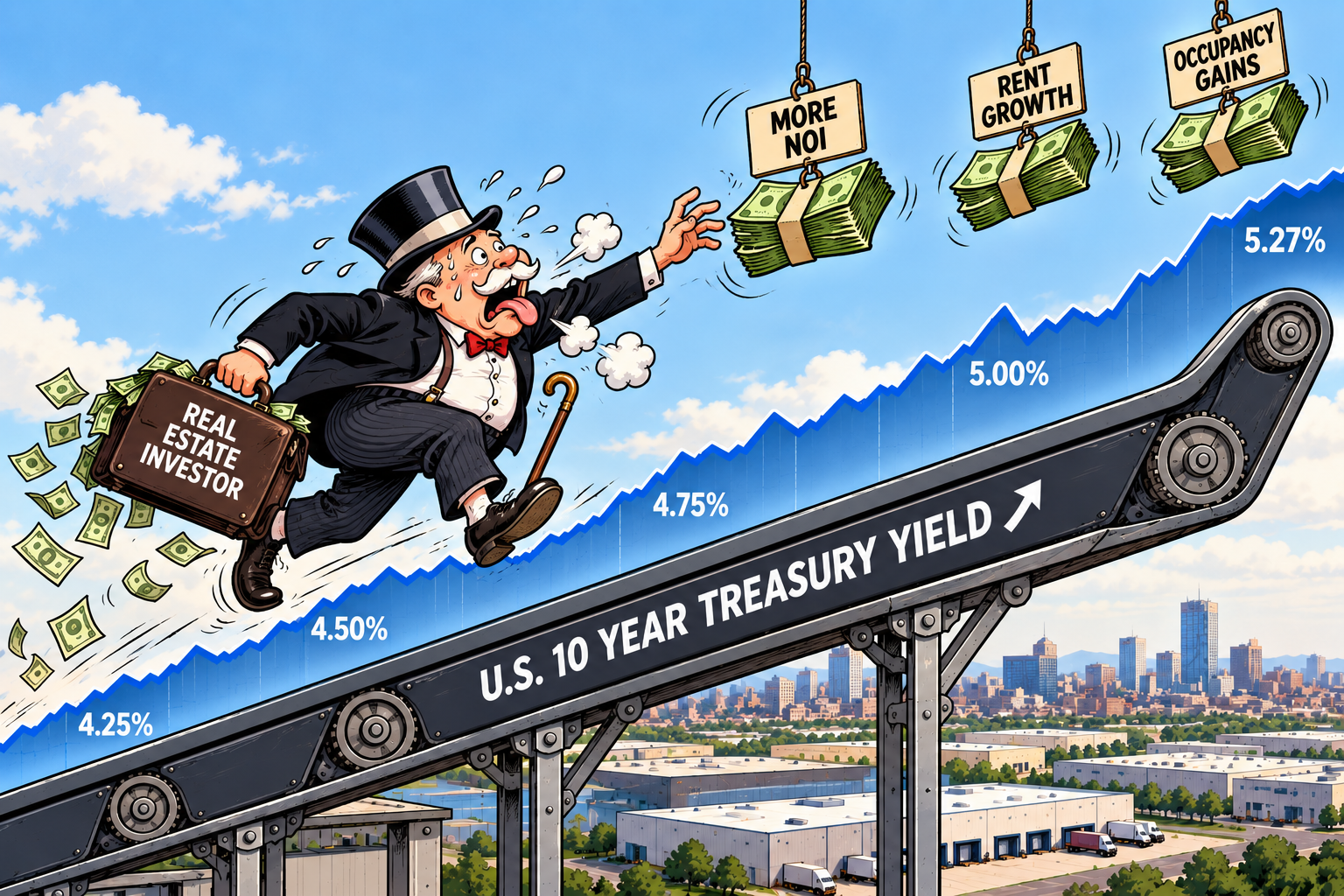
More and more we find ourselves in a world where we feel the weight of the cost of capital. Everyone in our industry has been transfixed the past few weeks as rates have gone up dramatically. The rate move by itself impacts both borrowing costs, as well as the direction of travel for cap rates. But I don’t think this is a blip to wait out. I think the game is about to change, again.
Here’s my view. I think we are heading into a pattern of rates continuously ratcheting up, on both the short end and the long end. We’ll get a slight reprieve, everyone will exhale, and then that reprieve just sets the new floor and rates move up again from there. If that’s right, you are really not going to get bailed out by cap rate compression. The direction of travel is cap rate expansion.
For most of our careers, real estate was played with the wind at your back. This has never been an easy business, but in the past you could buy, wait, and let falling rates and compressing cap rates do a lot of the work. That game is over. In the new one, the mechanism that creates value is a dramatic increase in NOI. The deals that are going to be liquid are the ones where somebody has done the heavy lift themselves, and grown the income by enough to offset the cap rate expansion.
The catch is that increasing NOI has never cost more. Capex costs never came down (if anything they are only trending upward), and the money to fund the work is expensive. Value add, as a business of buying to fix and resell, is new development’s cousin – the next to die when money gets too expensive. But it’s important to distinguish between TRUE value add – a comprehensive turnaround and complete repositioning of an asset, and simple “value add” which might mean mowing the lawn and re-negotiating leases when they come due. The simple version isn’t going to move NOI enough to outrun cap rate expansion. The TRUE version will, but it is brutally expensive to perform on borrowed money at a new basis. So the real question is who is actually positioned to do the work.
In most markets, there is a cohort of “value add” buyers, who buy properties on short term hold periods, perform the work and turnaround, and then sell at a profit to a longer term steward of the asset. In this new world, these buyers are getting squeezed out, and in many cases it makes sense for ownership to perform this work themselves and sell the asset fully stabilized direct to the long term steward.
Just to back up for a moment. When borrowing costs and cap rates go up, owners who want to sell have two choices; they can lower their price to reflect the new economic reality, or, if the property offers the opportunity, they can perform work and increase the NOI themselves, to a level which eclipses any lost value on the cap rate expansion. If rates keep setting new floors, waiting it out is not really a third choice.
My prediction is that we will NOT see a sudden seller capitulation on pricing, but rather, more sellers will either push their timelines out further, or decide it’s not the time to sell. I think that higher rates will lead to a further inventory constrained market. It may ironically force pricing higher for the right properties, as it’s likely to further restrict the supply of properties for sale. Key word being the “right” properties.
And I think this is the general theme; some properties will fetch record numbers on tight assumptions OR due to unique property features which serve specific users, and others will either not list or will languish as the true value doesn’t clear the bar which the seller would need to sell.
Higher rates, high oil prices, an overall sluggish but inflation burdened economy is having the effect of chilling leasing velocity. The only sub sector I’ve seen recently that has robust demand is in the contractor bay (small bay) market. That matters more than it looks like it does, because every value add thesis ultimately depends on leasing space. When velocity slows, the runway to stabilization stretches, and a stretched timeline on expensive money is what actually kills these deals because it just balloons the basis.
It’s pretty simple…. Who is better positioned to stomach downtime on a deal needing significant capex or a lease up – the legacy owner whose basis is $4M on a 200,000 SF building, or the new owner who will take out a 60-75% LTV loan at a 6-7% interest rate (or higher) on a $20-23M new basis. The answer isn’t close. In this environment position matters more than any “value add expertise”.
There are also only so many levers that can be pulled to “add value” on a multi-tenant industrial property. You can clean up leases with existing tenants, you can attract new tenants at market rates, you can make property improvements and open up new revenue streams on site by creating more rentable areas, and you can create ancillary income from things like solar installations, etc. There is a finite universe of plays. And the plays themselves don’t change based on who owns the building. What changes is what they cost to execute, and who is paying that cost.
It used to pay to sell the opportunity to perform these things to “value add” investors. Largely because capital was cheap. So from the seller’s perspective, the implied NPV of the future opportunity was high because the discount rate was low (or in other words, the seller was well compensated today for a “future” opportunity). Today that math is inverted. The discount rate is high, the buyer’s cost to execute is high, and so the price he will pay today for the right to do that work is low. The seller is no longer being paid for the future. He is being charged for it. There are always outlier situations where for one reason or another, it’s in the seller’s interest to sell the “opportunity” and not perform the work themselves, but in 9 out of 10 cases, my advice to sellers is for them to maximize the value add on the property, stabilize it to the highest ability, then list and sell.
Perhaps the biggest cost of a “value add” deal (depending on the extent of the value add opportunity), is that up until a certain point a buyer cannot obtain efficient financing. Having to close with majority equity, or a bridge loan is a major drag on basis. Bridge pricing plus the equity it takes to fill the gap can cost a buyer more in carry than the improvements cost to build. And that expense does not ultimately come out of the buyer’s pocket. It comes out of the number he is willing to put on your property.
When money is free, value add buyers multiply, because cheap capital lets them pay a very healthy number today for upside they haven’t created yet. That’s what makes the position work – buy from the legacy owner, perform the work, sell to the long term steward, keep the spread. Take the cheap capital away and the spread goes with it. His debt costs more, he can’t get that debt efficiently while the property is unstabilized, and the number he has to bid in order to still make a profit falls well below what the legacy owner will accept. The value add buyer doesn’t disappear entirely, but the list of situations where his position makes sense gets very short. The work still needs to get done. There’s just nobody left in the middle being paid a premium to do it.
Let’s also be clear…. Deferred maintenance is like a tax on property owners. There’s no measurable associated premium with leasing activity or income on the property, but not addressing maintenance routinely will slowly put the property at an increasing competitive disadvantage over time. Many owners kick the can, putting the issue out of sight and out of mind, and perhaps hoping that they can stick the next guy with the issue. This is again, something that gets overlooked when money is cheap, but something which becomes a real barrier when money is expensive.
Owners who have major deferred maintenance, which impede the ability to get the asset leased up (and specifically for assets with no cash flow) are quickly sinking into a hole. The time to address deferred maintenance would have been when you could borrow at 2-3%. At today’s rates, with today’s construction costs, the math is upside down a bulk of the time. It’s basically like someone who has been overspending on their credit card, only making the minimum payments, and now the bill is coming due.
In many cases, something which is not cash flowing at all is largely un-transactable, OR at a minimum…. The price it would need to sell for to justify adequate investment to bring it up to speed is substantially lower than it was just a few years ago.
Now, getting back to positioning…. Sellers do need to accept that borrowing costs are going up, and cap rates (meaning the actual cap rates where buyers will transact) also have to go up. And if I’m right about the ratchet, this is not a one time adjustment. The unlock for those sellers who really don’t want to push their timelines out much further, but who need to achieve a certain level of net sale proceeds, is to execute more of the value add themselves before bringing the asset to market.
And this is the piece I don’t think is fully appreciated yet. The same scope of work – the same roof, the same demising walls, the same fit out, the same lease up – costs two very different amounts of money depending on who performs it. The legacy owner funds it against a basis of a few million dollars, frequently out of existing cash flow, and every incremental dollar of NOI he creates gets capitalized on the way out the door. The buyer funds that identical scope on top of a record purchase price, with borrowed money at 6-7%, on a loan he likely can’t get efficiently in the first place. Then he discounts the entire exercise for execution risk, for time, and for his own profit. He is not paying you for the upside. He is paying you for the upside, minus his cost of capital, minus his construction budget, minus his contingency, minus what he needs to make for taking the risk. By the time that math runs, the seller has handed over a multiple of what the work would have cost him to perform himself. Performed on a legacy basis, that work gets paid for at the sale. Sold as an “opportunity”, that same work gets discounted at the sale.
None of this means every owner should go put on a construction hat. It means the decision has moved. The question is no longer whether you want to be in the construction business. It’s whether you would rather spend a dollar of your own money at your basis, or give up several dollars of price so that somebody else can spend it at theirs. For the owner who needs to hit a certain number, and who understands the market may not be coming back to him, performing the value add himself is the only realistic lever left to pull. Rates aren’t the lever. Cap rates aren’t the lever. NOI is the lever.
Every property is different. Every situation is different. Some don’t really have much more value you could squeeze out of a site. Some do. The test is a simple one; can I do things today that are going to drive the NOI significantly higher, and can I create it at my basis for less than the market is going to discount me for leaving it undone. When the answer is yes, that’s the move.
That’s the bigger picture. We are shifting into a new world, where nobody gets bailed out by the cap rate, and the players who stay in the game are the ones who can dramatically increase NOI.
Below, I’ve put numbers to it – a model which shows the impact of lost value due to cap rate expansion, and the level of NOI required to offset it. Includes assumptions to play with financing costs, refi scenarios, as well as a calculation which takes a target IRR (or equity multiple) and allows the user to back into the $ NOI increase required to hit it given the backdrop of cap rate expansion.
